Attachment Theory in Motion: Broken Promises Are...Still Broken Promises

The conversation is coming to an end. There is a steady but electrifying charge in the air. That fuzzy feeling of contentment and connection settles in your belly. You’re regulated. He’s regulated. Your nervous systems are in perfect harmony. Oxytocin floods your body, intensifying the bond.
In that low, husky voice reserved for late night intimacy, he says, “I’ll call you tomorrow.”
In the back of your head, you think: he usually takes two days to circle back after a particularly warm interaction. You want him to talk to you tomorrow, but you feel as if he isn’t going to.
And….the next day…crickets.
You’re not mad, but you can feel that faint prick of annoyance. If left unchecked, it will grow as he overzealously makes these promises that he does not yet have the capacity to keep. Especially if the promises deepen and predictably are never met.
Let’s not be naïve. This isn’t explicit, but in clear, secure communication, this is a promise. Casual, yes, but a promise anyway. And to be fair, your fox absolutely means this. He’s feeling a bit heady on all that oxytocin. In the moment, he wants more of you. He thinks he has capacity. But capacity requires stretching and slow growth. It means going a little farther each time. When your muscle is loose, you think, wow, why couldn’t I do this before? But the next day? It’s stiff. You have to slowly re-stretch to loosen it up again. Then stretch it more.
In other words, he can’t meet you at the same capacity every time. He needs to warm up, try it again and again before that muscle’s baseline changes. That takes calibration and intent. And it doesn’t happen overnight.
You know that. You feel more confident about his patterns than his words. What do you do? Stop investing in his promises and rely on his behavior? Confront him about it? Let it go?
Before we answer that, we should see this issue clearly. A broken promise made with intent is still…a broken promise. It’s a breach of congruence and can erode trust down the line. Sure, you can understand it. You probably empathize deeply (that’s your superpower and your kryptonite). But comprehension and compassion don’t override your nervous system, your sense of harmony, your balance. For your wellbeing and to strengthen your attachment bond, you may have to address it.
Timing here matters. You must be regulated. He needs to be regulated.
Most importantly, we need to keep in mind that this is not a reaction. We want to lay groundwork for future behavior, not correct the past.
Furthermore, a pattern must form. Once an identifiable pattern has formed, not just a one off or a bad day, that is when a re-calibrating conversation is appropriate. But to be clear: you get to decide if you’ll wait for a pattern. Ideally, a pattern is a problem, a one-off is a mistake, but you are the one who will have to live with the fallout, so you are the judge and jury.
Let’s say this is the third time he’s overpromised beyond his capacity. He’s not being malicious, but his behavior does affect you and needs to change for you to have a future. You decide it’s time to recalibrate. You plan.
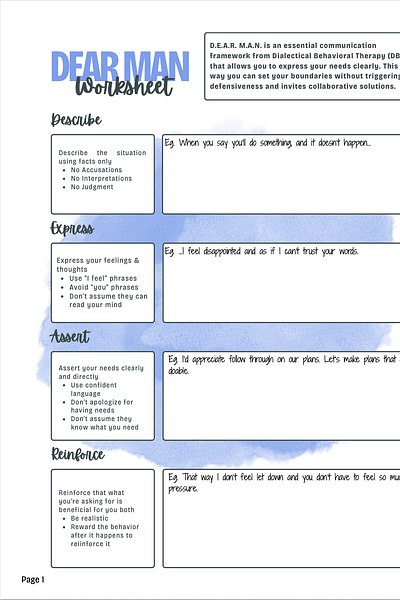
And you know that one of the most effective ways of communication comes from Marsha M. Linehan’s Dialectic Behavioral Therapy: the acronym DEAR MAN. I know, what? For me, when I am trying to communicate my strong feelings, I overshare, overexplain, start wandering here and there, and suddenly the entire thread is lost and I’m being dismissed for being chaotic and dramatic. I lost all the power somewhere along the way. So having a clear map for how to communicate important matters effectively, even in high stakes interactions, is actually very reassuring and empowering.
Let’s see it in motion:
D: Describe: Describe the situation using the facts and only the facts. No interpretations, no accusations, no emotions. Eg. When you say you’ll do something, and it doesn’t happen…
E: Express: Express your feelings and opinions here using “I feel” statements (not accusatory “you” statements). We should never expect people to read our minds (they can’t) and we shouldn’t expect them to arrive to the same conclusions as we do (they won’t). Eg. …I feel disappointed and as if I can’t trust your words.
A: Assert: Assert your need clearly, directly, and calmly. No apologizing for having needs. Be polite. Use confident language. Don’t assume they know what you need. Eg. I’d appreciate follow through on our plans. Let’s make plans that are doable.
R: Reinforce: Reinforce that what you’re asking for is beneficial for both of you. Be realistic. And remember to reward the behavior after the fact. Eg. That way I don’t feel let down and you don’t have to feel so much pressure.
-
M: Mindful: Be mindful of the topic. Don’t get distracted. Repeat yourself if necessary and ignore any attacks that come your way. Stay grounded. Keep reinforcing the point.
A: Appear Confident: Use a steady voice and confident language (no, “I’m sorry” or “I don’t know” etc.). Use confident body language: chin up, eye contact, no shrinking. Remember, we also want to maintain emotional safety here, but you can still appear confident while radiating warmth and compassion.
N: Negotiate: Be ready to give in order to receive. Be willing to compromise. Invite them to participate in alterative solutions—avoidants especially need to feel as if they are not losing control and they have options, plus only they know what they can realistically commit to. Focus on what will work for both of you, and be prepared to reduce your request. Eg. What do you think? Can you think of something that might work better for you?
You aren’t sure if you can manage it without forgetting something or getting flustered or your hands shaking, so you decide to write down exactly what you’re going to say and rehearse it beforehand so the words don’t feel foreign when you use them and your tone can remain steady.
When you both have time and you are both calm and regulated, you take three deep belly breaths and bring it up. He may bristle, he may stay quiet—he can react countless ways—but the point is, you did everything in your power to communicate and bridge a collaboration on a problem. You provided emotional safety and gave him room to suggest alternative solutions. You let him maintain autonomy while still participating in the partnership and meeting your needs.
That’s boundary setting, that’s addressing issues, and that’s communication.
One last word here, did you notice this all came from him not calling the next day? You might be thinking, that’s a minuscule issue to bring up. I chose a “minor” issue because minor issues usually snowball into big resentments later. Once you are resentful of someone, it’s hard to walk it back. Address the issue early on. It will help weed out those who will be incompatible long term, and it protects your bond from festering resentment later.
I have created a DEAR MAN worksheet to help you structure your own recalibration conversations. You can download the PDF below for free.